


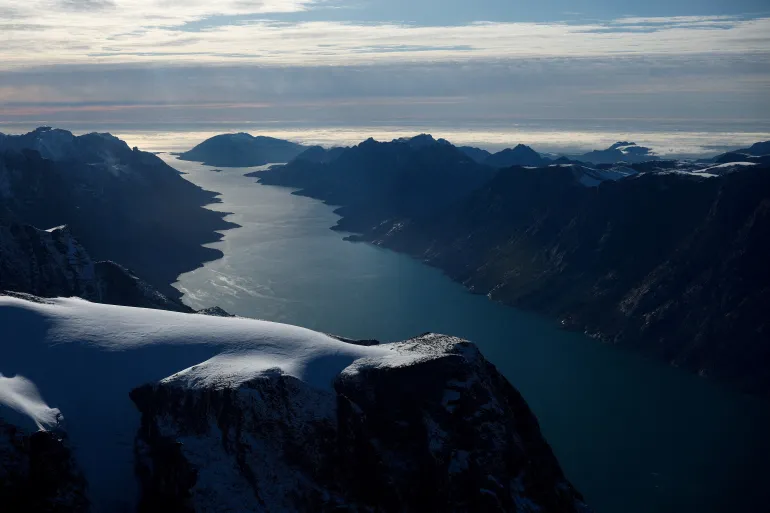
United States of America buying Greenland is not a novel thought- however, when Donald Trump became president of the United States he brought the issue into the international news yet again when he brought up the possibility of the United States purchasing the large Arctic island of Greenland, which is part of Denmark. This proposal was commonly ridiculed at the time and evently dismissed by the leaders of Denmark and Greenland. However, there is also a new discussion in certain political and strategic quarters about a new Trump administration being fixed on the intention to possess Greenland as to whether there are any hard ways it might seek to make it happen?
Although it is extremely unlikely that these can be taken either outright, the subsequent discussion of the hypothetical “hard” options she is exploring can offer an insight into American power, international law and the increased strategic significance of the Arctic.
What is So Significant about Greenland?
To look through the situations, it is essential to figure out why Greenland is so strategically valuable:
Geopolitical position: Greenland is located between North America, Europe, and the Arctic Ocean-it is the best position in regard to defense of the missiles, surveillance, and power projection.
Military importance: U.S. already has its own Pituffik Space Base (previously called Thule Air Base) built as one of the units of the U.S. early-warning and space-tracking systems.
Natural resources Greenland contains rare earth minerals, uranium and other valuable materials that have become essential in the current economies.
Arctic rivalry: Melting ice is creating new paths of shipping and accessing of resources, and the rivalry between the U.S., Russia, and China is becoming more intense.
All this taken into consideration, Greenland is much more than an in the middle of ice island–Greenland is a strategic prize.
What Does Hard Ways mean?
Hard ways in geopolitical language are the forceful or coercion-based methods, instead of the willingness and diplomacy. Such strategies would challenge global conventions and may seriously upset world relations.
These are the key scenarios that the analysts can refer to, and all of them are not simple, legal or risk-free.
The Forced Control or Military Occupation.
The Scenario
The most radical would be use of the U.S. military force to occupy Greenland or develop the dominance of the major infrastructure, especially military stations and ports.
Why It’s Unlikely
Greenland is an autonomous area of Denmark, one of the members of NATO.
It would be against the Charter of the UN and the international law because military action would occur.
An assault against the territory of Denmark might spark the Article 5 of NATO, which is that of collective defense against the United States.
It would be breaking of alliances and isolating Washington diplomatically.
Bottom Line
This will be a step that has never been taken before and one that will be disastrous to a member of NATO. The very mention of it throws the impossibility of the option.
Coercive Economics of Pressure on Denmark.
The Scenario
An alternative approach is to coerce Denmark, via a Trump administration, when Sweden contradicts Greenland demands with economic sanctions or trade penalties or diplomatic pressure to make concessions.
How It Might Look
Islamic threats to trade limits on Danish or EU products.
Taking advantage of the influence of U.S. in NATO or international organizations.
Putting political pressure by bilateral agreements.
The Limits
Denmark was able to unite European Union to put up a joint defense.
The economy of the EU overshadows the one of Denmark, making it less of an leverage to the U.S.
Attempts to economically coerce allies will be met with retaliation and its long-term drawback towards the credibility of the U.S.
Taking advantage of Greenlandic Independence Movements.
The Scenario
The independence movement in Greenland is rather strong being supported by the cultural identity and economic ambitions. One of the hard strategies might be to support or influence this flow so as to undermine the power of Denmark.
Potential Tactics
Providing huge investment packages by the U.S.
Security guarantee or preferential treatment.
Silently took sides in politics towards becoming more aligned with the U. S.
Why This Is Sensitive
Greenlandic leaders have kept on reiterating it that they are not on sale.
Independence does not necessarily imply standing in line with the U.S.
Any feeling of foreign intervention would attract retaliation at the local and international level.
This is a middle ground, less blatant than military action but a nevertheless unethical and diplomatic one.
Entrenchment Strategy but not by ownership.
The Scenario
The U.S. might also prefer to establish de facto control of Greenland through increased military, economic and political presence rather than through taking possession of it.
How This Could Happen
Increasing the U.S. bases and surveillance.
Pre-eminent infrastructure projects and mining.
turning out to be the foremost economic and security partner of Greenland.
Why It’s More Realistic
In so doing, this strategy does not afford a legal transition to sovereignty but nonetheless attains numerous U.S. strategic objectives. However, it still risks:
Alienating Denmark
Domesticating apprehensions of neo-colonialism.
Growing stress with the Russian and Chinese.
Legal and Moral Barriers
Despite the approach, there are tremendous challenges:
The sovereignty of territories is greatly guarded by the international law.
Greenlanders are known to have a right of self-determination.
The unity of NATO rests on the basis of trust, any form of coercion would destroy the coalition.
The precedent would empower other powers to expand its territories through use of force.
The Reality Check
Regular headlines notwithstanding, the reality is clear: the hard way to take Greenland will have to be huge, on part of the U.S. Any force would most probably hurt American interests more than it would help.
What is truly disclosed in the discussion is not a scheme to occupy land-mass-areas-where-lands-meet-sea-no more-land-beyond-evaluate-here-before-the-sea-erodes-cliff-with-the-lords-temporarily-before-they-are-capeticed-off-with-the-lands-they-need-not-they-need-not-they-need-not-they-need-not-they-need-not-they-need-not-they-need-not-they
Final Thoughts
Whether it will or will not happen so hard to take Greenland is not the question, but rather what should never happen. The future that awaits Greenland is finally in the hands of the people–but not foreign powers no matter how strategic the island of Greenland may be.
With the steepening of warming of Arctic geopolitics, collaboration, observation of regarding sovereignty, and multilateralism is the sole remedy.