


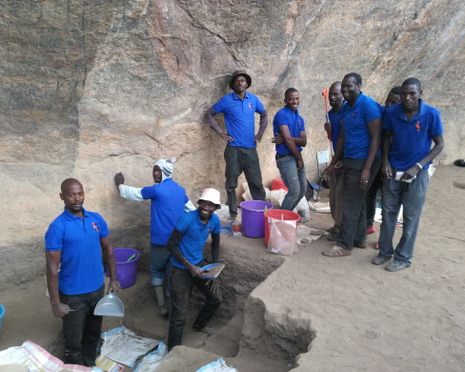
People In what is turning out to be a groundbreaking twist in interpreting the prehistoric human behavior, the archaeologists have discovered what is deemed to be the first-known cremation pyre in Africa and contained adult human remains in it, some 9,500 years ago. Discovered by the Hora 1 archaeological site now in the Northern part of Malawi near Mount Hora, this is unknown heritage providing a unique and interesting insight into the life and ritual of simply hunter-gatherer societies.
A Ritual Lost for Millennia
Hitherto, there was practically no evidence of purposeful cremation in the hunter-gatherer history of Africa. Although elsewhere found burnt bones have been dated to 40000 years old, e.g. the burnt remains at Lake Mungo in Australia, these were not accompanied by standing pyres that could be cremated. In Africa, constructed pyres, which were confirmed as to date, were as old as 3500 years ago.
What this discovery altered is the fact that researchers discovered a huge amount of ash that contained fragments of bones belonging to human beings, and this proved beyond any doubt that it was not just a fire accident but a cremation performed with purpose on open fire.
What Did They Find?
This is what the painstaking excavation and examination showed:
[?] The Individual
The skeleton of a woman aged between about 18 and 60 years with a height of slightly under five feet is the owner of the remains.
Approximately 170 bone pieces were taken out of the ash layer.
The Pyre and Fire
Such analysis with a microscope and sediments reveals that the pyre was a deliberate formation – not a big fire.
It is estimated that temperatures were up to 930-1000degF (500degC), which implies the fire was run and maintained.
To do this, the amount of fuel needed (at least) would have been calculated to be 65-66 pounds (30 kg) – a significant social work by the hunter-gatherer tribes.
[?][?] Body Treatment
Certain bones bear cut marks, suggesting that the remains had been deliberately mutilated like defleasement and burnt off.
Surprisingly, there are no skull or teeth remains and researchers believe that this might imply that the skull was also cut off before handling by the cremation process.
These facts suggest the existence of elaborate mortuary behaviour – not merely a case of getting rid of a dead body, but a form of ritualized death ceremony that demanded work and organization on a large scale.
Riots and Social Complexity.
What does it tell us about the cultures of the ancient hunter-gatherers?
Cooperation and Symbolism
On a scale like this, cremation implies a concerted group activity and joint investment in rituals. It was not easy and incidental to provide sufficient fuel and maintain a large sustained fire, as required, among mobile hunter-gatherers. The very fact that they did, betrays an ability to develop a planned, symbolicized interaction with death, that not was previously realized.
A Place of Significance
This was not the place chosen just by chance at the foot of Mount Hora. The site was the location of large fires prior to and following the cremation indicating that it might have been used over a long period of time as a symbol- a site of memory or ritual importance across generations.
Questions that Remain
Some of the questions remain a puzzle to archaeologists:
What was the reason why this individual was burnt with such focus?
Were there any special positions within her community?
Was this a ritual of some general religious conception, or an event in itself?
At the present, these are unresolved mysteries.
Bigger Picture: Essays to Read Before Turning the Television On.
It is a revelation that would redefine the timeline of the elaborate practice of rituals in ancient Africa, moving the origin of the practice by several thousand years. It shows that the early hunter-gatherers of the Holocene period were not merely living to survive, but they were well able to engage in complex social behaviours and symbolic thinking regarding life, death, and remembrance.
To a wider archaeological view it also serves as a reminder that human rituals did not emerge abruptly along with agriculture and civilized communities, but were presumably a developing aspect of how humans came to make sense of their world well before the development of agriculture.
Closing Thoughts
This 9,500-year-old cremation pyre was discovered near Mount Hora; it is both a scientific success at this point; it is a human story. It shows memory, intention and maybe even emotion that was saved in ash.
This find can only hold future interpretations of the environment and how we learn about the social scenery of the deep past, however, as scholars continue to deconstruct the site and its surrounding, additional findings are likely to influence the way we interpret the social horizons of the ancient ourselves and how people of the early times dealt with the memory of their lost ones.